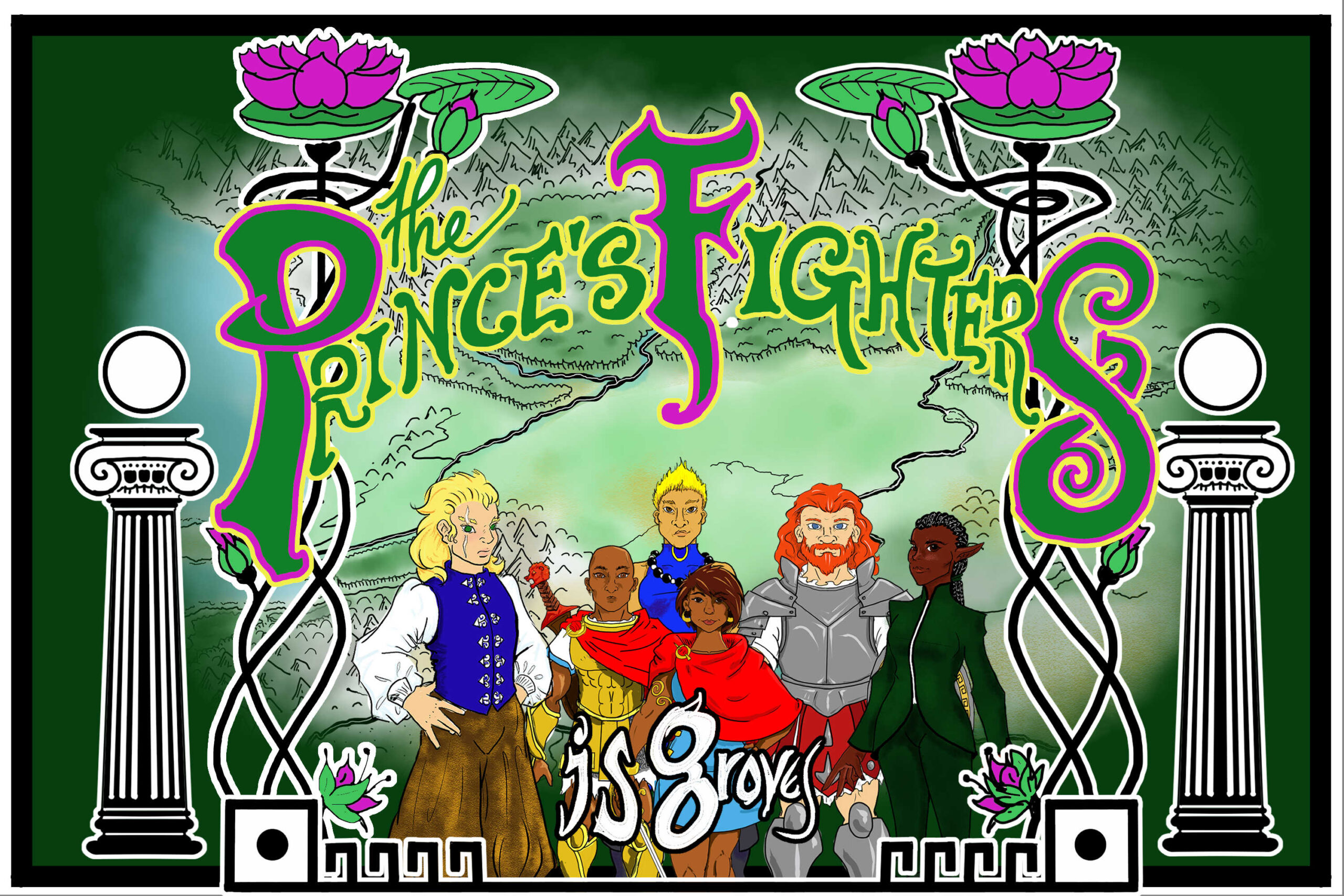
Nothing had prepared me for the true splendor of Vencar City. The gargantuan walls with their elaborate bronze-clad gates and the lovely caryatids that flanked them. The impossible towers that soared even higher than the walls, countless fingers reaching for the distant sky. The broad boulevards, paved in granite. The tall buildings of stone and concrete, wood and stucco. Restraunts and kitchens and wineries on almost every corner, service counters cut out of their very walls. Family compounds like fortresses, flanked on every side by apartment buildings or workshops or offices, no two alike. Vivid murals and graffiti warred for wall space and the attention of pedestrians passing by. Parks and temples springing out of nowhere, once beyond the boundaries of the city walls, now surrounded on all sides.
Perhaps Ghol Vidar had been grander, but it seemed unfair to compare the work of mortals to that semi-divine edifice, and the knowledge that it had been built by slaves would forever stain its grandeur, at least for me. Loyalty demanded that I say Tanirinaal was more beautiful, but that was like saying a rose was more beautiful than a ruby; truly, how could one compare the two?
Nowhere else had I yet seen such diversity of peoples. Humans, mostly, yes, but in all their varieties: tall and short, thin and fat, light and dark, dressed in every imaginable combination of idiosyncratic style and current fashion and national costume. Just in those first hours, I saw a Shan Khul Master and a Citrine Knight and a violet-eyed desert nomad, a man in a Georgi dress and a woman in tight Handari hose and countless costumes I could not even name, all amidst the tunics and chitons and peploses native to Vencar.
And not just humans: elves and dwarves, some of whom were obviously tourists and some who had clearly settled here decades if not generations ago. I saw devas and djinn, too, from the great Sacred Desert: faces and hands marked with blue and gold whorls that some said were tattoos and others claimed were the very skins of their immortal bodies. I saw uncanny nymphs and satyrs, with furry thighs and cloven feet or faces like treebark or hair like clover.
When I had left my tower, two years ago, this had been my ultimate destination. I had planned to visit my family at our compound while spring warmed a bit, and then cousins in `Aasmiir, and my Aunt Neriishai in Tanirinaal – as I had done. From there, I had planned to buy ship’s passage south, perhaps partaking of the culture in the river-ports while I looked for opportunities to prove myself and my mastery, but with Vencar City firmly in mind.
Instead, I had met Elana and her – soon, our – companions on the road. Like dozens of my people, I had been drawn in by her charisma and the romance of her quest.
But joining my quest to Elana’s had raised the stakes of my quest exponentially. It was not unheard of for a journeyman wizard to put her life on the line in pursuit of proving her mastery, but it was hardly expected. How many times had I almost died since joining the Prince’s Fighters? How many times, just on the quest for the Blade of Xadaer? Dozens, easily.
And I was yet young. I had yet to see a whole century of life, and most elves expected to live at least two. Sorceresses, our greatest queens among them, routinely lived for more than three hundred years, and sometimes more than four. Wizards lived longer than other humans, I knew; how long might I live, if I survived? How much life was I risking to be recognized by my order and see Elana elevated to her father’s throne?
Our quest, so far, had taken me beyond the boundaries of the mortal world and back. It had thrown me in the face of my greatest fears and I had come out stronger, if perhaps sadder. And now, at last, our conjoined quests had brought us, together, to Vencar City.
In theory, I had friends here. Aeginana Horae and her apprentice Heptima Clarissa, with whom my master and I had corresponded so often throughout my apprenticeship. Unzer del Kemlin only wintered in Vencar City; he would be back north, by now, at his cousin’s estate in Georg City or his family home in Kemlin, from whence had come Maris’ favorite cheeses. Prima Ignata, my master’s first apprentice, who had led several expeditions of friends, allies, and relatives to visit Maris Pello in exile, and who had always been kind to me. A dozen other colleagues and acquaintances, known to me through my master’s correspondence and my own.
Somewhere in this densely packed metropolis lay the Pello estate to which I was heir, and all the worldly goods that he’d accumulated. Somewhere in the city hid the citadel of my wizard order, its location known only to full initiates and their apprentices.
And somewhere, not far from the palace, itself, lay Maris Pello’s magnum opus: the magical labyrinth he had designed and enchanted for Elana’s grandfather, the emperor Dorian Traianus II. Two dozen stone chambers cut into the very bedrock below the capitol, made to confine wizards too powerful, politically or magically, to exile or execute, all interspersed throughout a maze of halls enchanted to both suppress wizardry and confuse and befuddle any who walked them. And, above that, the halls and towers of the Order of Truth-Seekers, established by the Emperor Dorian to protect the mortal populace against the works of incautious and predatory wizards. I had never seen it, of course, but I had found his notes, hidden among his other papers, when he died.
Of those friends and allies I should have in the City, who could I call upon without putting them – and us – at unconscionable risk? I certainly could not go to the Citadel of the Black Mask without risking being turned over to the emperor. How often in Liddarn had I been looked askance at, reminded that my order had sided with the Usurper in the last war of succession? Too often.
Derrek Rowan had proclaimed my journeyman’s quest long complete, my mastery well established. I was honored and flattered by his praise and, whatever he said about being gainsaid for my allegiance to the prince or his betrayal of the emperor, I doubted that any would question his judgement. But, master wizard or not, in my heart of hearts, I did not think my own quest would feel complete until I could finish it as I had originally intended: in the great hall of the Pello estate, formally recognized by my order.
===
We chose an inn in the middle of the city, in a neighborhood that Derrek assured us was a mere half-hour’s walk to the secret passage which he assured us would still be there and unguarded, ten years after he had ushered Elana and Rennin to safety. The buildings were lower, here, and closer: only two or three stories, each, more concrete than wood or stone, open shop-fronts alternating with enclosed courtyards. Windows and courtyard walls were protected by wood or iron bars, and by shards of glass and metal caltrops embedded in the surface of the concrete. Laundry hung from wires across certain streets, waving in the wind. The smells of human bodies and human wastes warred for dominance with the smells of smoke and fried and frying onions and flatbreads and fishes and fish sauces.
Shop fronts were most easily discernable not by their windows, but by the youths outside shouting the nature and quality of their contents. Leather harnesses for men, women, or horses; prettiest stitching in the district. Hats and scarves and yarn. Kabobs: chicken, fish, or lamb. Prettiest pornai for half a mile.
We chose an inn whose crier promised the freshest fish and the best fish sauce in the city, and the cleanest rooms in the district. We doubted the first claim and prayed for the last. The courtyard gave us good hope: fragrantly flowering bushes burst from vessels that hung from the walls. The tables and benches that circled the rainpool were well worn and well swept, and more than half full of laughing and chatting customers. The rooms, where we dropped our bags before returning to the garden for a dinner, were certainly cleaner than some we’d seen, or any of the fields where we’d slept over the last year.
Dinner consisted of fried onions and roasted fish on rice and flat bread, half-drowned in garum, the spicy salty fermented fish sauce for which Vencar City was famous. I had had something like it at a handful of state dinners with the court-in-exile. I did, I decided, like this version better.
The flowers and the fresh-cooked food helped crowd out the less pleasant city smells, but even so I could only stand to stay in the courtyard for as long as it took to finish our meal. Apparently even the unflappable and urbane folk of Vencar city could not keep themselves from staring at an elf. Only Rennin’s glower, and the hand on his sword, kept them at arm’s length, and I retired to my room as quickly as possible.
Derrek came with me, and we lay in the bed together, letting the evening breeze blow over us through the window while we contemplated our mortality.
In the morning, Elana went to the nearest sanctuary of the Triumvirate. To my surprise, she chose me as her escort and bodyguard, and bought us both scarves to cover our heads – partly an act of modesty, partly a disguise, and partly, I hoped, a small sign of forgiveness for the lie that had first brought us together. The journey took us to a neighborhood nearer the outer walls, nicer than the one where we’d taken our inn, but not as nice as it had been before the city had grown to surround it. I could see that the roads had been wider, once, and tall apartment buildings rose up in spaces that had clearly once been the gardens between estates that were now in decline.
The sanctuary complex was so far safe from such incursions. High walls had been built around the ancient sanctuary and lower walls raised up around those, with a lovingly maintained garden in between. Joining the inner and outer wall, and butting up against the street, was an outer temple consisting of a wide roof over steps that led up to a small, dark enclosure with no doors.
I stood with her as she bought a dove on the steps of the outer temple, and then when she handed the bird over to the offered it to the priest as a sacrifice. The priest, an old man with gnarled hands and a deeply wrinkled face, took the bird to the altar, a stone slab before a four-part statue depicting the gods Althaeruh, Esthraal, and Dalthuu, below a set of triangles, each marked with the celestial character that served as the root of one god’s name: Aeruh, Es, Dal. The priest’s knife flashed in the twilight of the altar room. The sight of blood spilled on an altar made me deeply uncomfortable, ameliorated only slightly by the knowledge that the flesh of the bird would become dinner for the priest and the charity he likely served.
I was not an initiate of these mysteries, and I could not go deeper into the complex, so I waited while Elana tended to her spiritual obligations. I spent my time examining the idols in the outer sanctuary. Althaeruh was one of the first gods of humankind, the patron of fallen a’Rasyr as Shiithaia and Astennuu had been patrons of Illustria. But Esthraal and Dalthuu were the father-gods of elves and dwarves, respectively, and I did not understood how they had come to feature in a Vencari mystery cult. The image of Esthraal was barely recognizable as llamenan, let alone the father of our people: his ears barely pointed, his eyes too small, and face bare – without the distinctive geometries that marked the masked faces of llamenan divinities. I wondered what the rrotran thought of the Dalthuu of the Triumvirate?
When Elana emerged, some hours later, her face was marked with pigment and holy oils and her eyes were glossy with ecstasy.
“I know much of it is oathbound,” I said, then asked anyway. “But … what do the mysteries offer you?”
“The Triumvirate promises justice,” she told me. “Justice and order, in life and in death.”
The next morning, Rennin made his own pilgrimage, alone. He returned late that evening, our laundry in hand, and bearing news from the north.
“There has been fighting,” he said. “No one is reporting a great battle, so casualties have apparently been minimal, so far, but Liddarn is officially under siege. Some of our allies are gathering additional forces in Rambleholt, to the east. And there are rumors that Georg is marching to our aid after the second Great Wizard came out of hiding to set a contingent of imperial soldiers on fire. Apparently, Derrek, your work could be seen from ten miles away.”
Derrek grimaced and nodded. None of the news was comforting, but it was all better than we had hoped.
We went over the plan one last time. It didn’t take long. The plan was impossible, not complicated. We went to bed knowing that this night might be our last. I could still taste Derrek in my mouth when I awoke, and myself in his mouth when he kissed me good morning.
“Whatever else happens today,” he said to me, his eyes glassy and his voice tight, “know that I will do everything in my power to make sure you live and walk free.”
I swallowed hard and buried my face in his neck.
“And the others?” I asked. “And yourself?”
“I don’t love them,” he said.
Sweet and merciful gods, Derrek, I thought to myself. That’s how you tell me?
I wanted to confront him about that, and about the suggestion that he didn’t love himself. And the fact that he made no promises about Elana and Rennin really bore reiteration. But I didn’t have the words. Instead, I just said, “I love you, too.”
And I wished that I could say it to Rrii`aa one more time, as well.
< Previous Chapter| Home | The World | Next Chapter >
Thank you so much for reading!
New chapters drop every Sunday morning barring unexpected circumstances. New maps and art drop when I finish them, any time except Sunday morning. For the inside scoop, other stories set in Dathl’lyr, access to new chapters six weeks before they go public, and/or a look into all the other things I do, please consider joining my Patreoncampaign! Don’t like Patreon or just want to support my work? Drop a tip in my jar over at Ko-Fi!